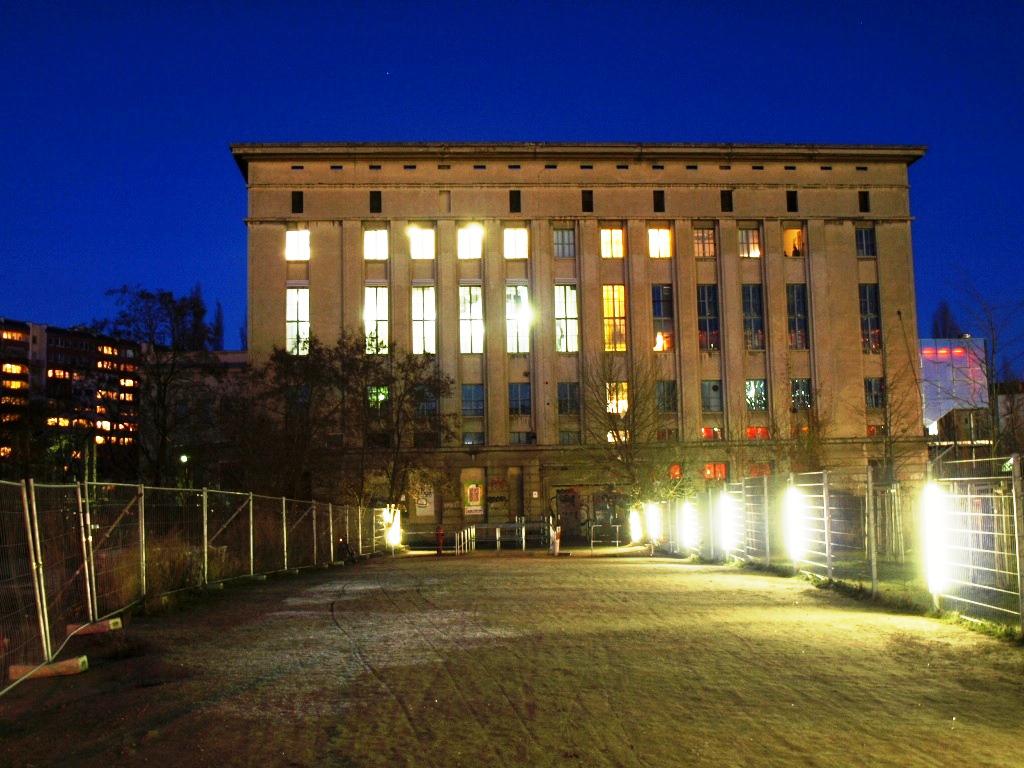


The Berghain is located in a district heating plant from 1953, which the operators bought themselves in 2010. There are 18 meters of air above the dance floor, the sound is provided by four Funktion-One towers, and upstairs in the Panorama Bar, house plays instead of techno. Among Berlin's techno clubs, this one has the toughest door, as cameras are taped over and there are no mirrors.
Berghain: Techno in a former heating plant
The building at Wriezener Güterbahnhof was built in 1953 and 1954 as a district heating plant, in the style of Socialist Classicism, and is now a listed building as part of the Karl-Marx-Allee ensemble. Norbert Thormann and Michael Teufele had previously run the club Ostgut on Mühlenstraße; when it had to close in 2003, they moved into the empty hall. In October 2004, the Panorama Bar opened first in the former control room, shortly thereafter the main hall. In 2010 and 2011, the operators bought the building, which they had previously rented from Bewag. The main floor holds about 500 people, the whole house about 1,500, and there are 18 meters of air above the dance floor up to the ceiling, a dimension that you hear before you see it. In 2009, Berghain was ranked number one in DJ Mag’s Top 100 Clubs, and in 2016 it was recognized as a cultural venue for tax purposes.
Four Funktion One towers and the rooms around them
The sound on the main floor is made by four Funktion-One towers standing around the dance floor; the Panorama Bar received a line array with six subwoofers in 2017. The ground floor houses the box office and cloakroom, and since 2017 also the Säule, its own small floor in the former darkroom. In addition, there is the Halle am Berghain for exhibitions, the Kantine for concerts, the Lab.oratory with its own entrance, and in summer, the garden. Musically, the house is divided: techno in the main hall, house and deep house upstairs in the Panorama Bar, with Marcel Dettmann, Ben Klock, Nick Höppner, Tama Sumo, and Virginia as defining residents and the in-house label Ostgut Ton supporting them. At the door, Sven Marquardt’s team decides without explanation, a ticket is not a guarantee, and mobile phone cameras are taped over at the entrance. There are no mirrors in the club.

Top10 Redaktion
Erfahrungsbericht vom 27.09.2026
Price level
The Klubnacht costs around 28 to 30 Euros at the box office. Single events start at about 14 Euros, large specials are up to 42 Euros.
Tickets
There is no pre-sale for Klubnacht; payment is made at the box office. A ticket does not guarantee entry.
Photos
There is a strict photo ban in the club, which is why mobile phone cameras are taped over at the entrance.
Accessibility
Access is at ground level, toilets are barrier-free, and all floors are accessible by elevator with staff assistance. An accompanying person with disability marker B pays no entrance fee.
Public transport
It's about a five-minute walk from Ostbahnhof, alternatively, the S-Bahn stops at Warschauer Straße station.
Highlight
The house includes the Halle am Berghain with exhibitions, the Kantine for concerts, and in summer, the garden. Free drinking water is available at the washrooms.
Opening Hours
- Fri, Sat - Sun: depending on the event
Address
Am Wriezener Bahnhof 1, 10243 Berlin, Deutschland